Promethean Voidwalker

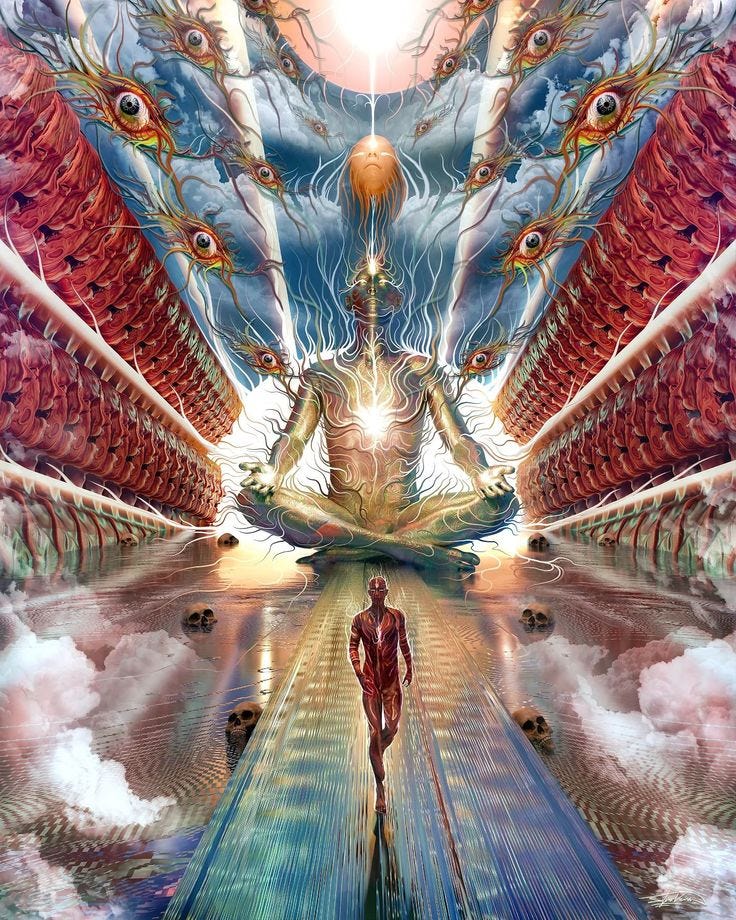
Jorjani’s Thanosis is a penetrating compendium of all things post-mortem survival but where it really shines is in its service for those who intend to engage psychotronics not merely as intellectual study but as skillful praxis. What quickly becomes apparent as the data mounts in support of life beyond the physical body is that there is a pressing need for action – if even a fraction of the evidence is accurate then there would be little that is of greater importance than mastering the techne of soul-survival.
What Jorjani provides is existential grounding within a philosophical orientation capable of igniting and sustaining the Promethean will – that vitalistic ethos required to forge for ourselves not only the vessel by which we navigate worlds but the psychic container capable of holding the esoteric means potent enough to alter the very fabric of those worlds.
But what if this vessel, this container – this vehicle – that carries us from incarnation to incarnation is none other than the architecture of one’s own mind? And if that is so, what could yield greater metaphysical dividends than consciously crafting that very architecture – an undertaking that amounts to nothing less than the act of soul-creation? The answer is obvious but only to those that understand the nature and gravity of the situation we find ourselves in. The control system is deeply embedded and the illusion is highly sophisticated – yet even still, knowledge continues to proliferate and there is no better time than the present to take practical steps toward liberation.
The Buddhists refer to this lifetime as precious human rebirth for a reason: the energies upon death are intense, the phenomena within the bardo overwhelming, and for an untrained mind this torrent almost inevitably ends with entrapment – a seamless slide back into the Archontic machinery of samsaric inertia. As Jorjani says, “The untrained are processed, sedated, or harvested in conversion wards and loosh farms, while the trained arrive as pilots – stabilizing carriers, transmuting affect into propulsion, and refusing capture by hostile attractors.”
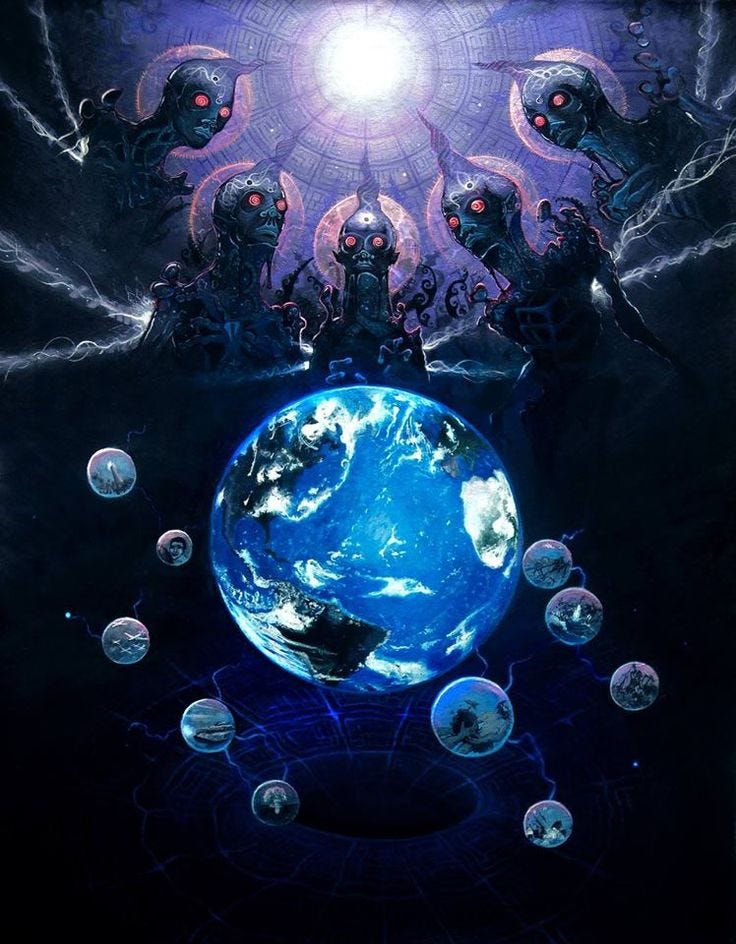
But what is this vessel that is the individual? What is the conventional self that is reincarnated? Jorjani describes the soul as the following:
… an informational architecture arising, enduring, being processed, and transformed in a quantum computational cosmos. … The ‘soul’ is the persisting configuration of informational states — an integrated pattern of memories, dispositions, and experiential traces — maintained not in the fragile, perishable neurons of the mortal brain but in an extracorporeal substrate.
The soul, then, is not a fixed or final self. It is not a static identity or a set, ossified form, but a fluid constellation of aggregates – radically malleable and plastic. The soul or self is not something one merely “is,” but something that is always being shaped. One is not doomed along a fixed trajectory but is instead afforded the freedom to determine one’s own telos, that is, IF one is armed with the requisite knowledge and IF one resolves to develop the essential dynamic will. What stands out yet again is the pressing need to embrace an ethos of vitalism: to consciously craft the vessel that is the soul, to intentionally weave the subtle body, and to seize sovereignty of mind.
Shunyata, the Nature of Truth, and Gnostic Cosmology as Psychotronic Manual
The further one pierces the veil the more the clearer it becomes that the single most consequential realization is the evolution of mind. This means both the stabilization of primordial consciousness – Rigpa of the Dzogchenpas and perhaps the Divine Spark of the Gnostics – as well as the purposeful cultivation of the containing vessel of consciousness (that which gives quality and character to experience). The former is of utmost importance precisely to avoid the snare of reification within the latter – the realization of Shunyata, or the emptiness of inherent self-existence, guards against attributing ultimate status to that which is conventional in nature: the primordial error of samsara.
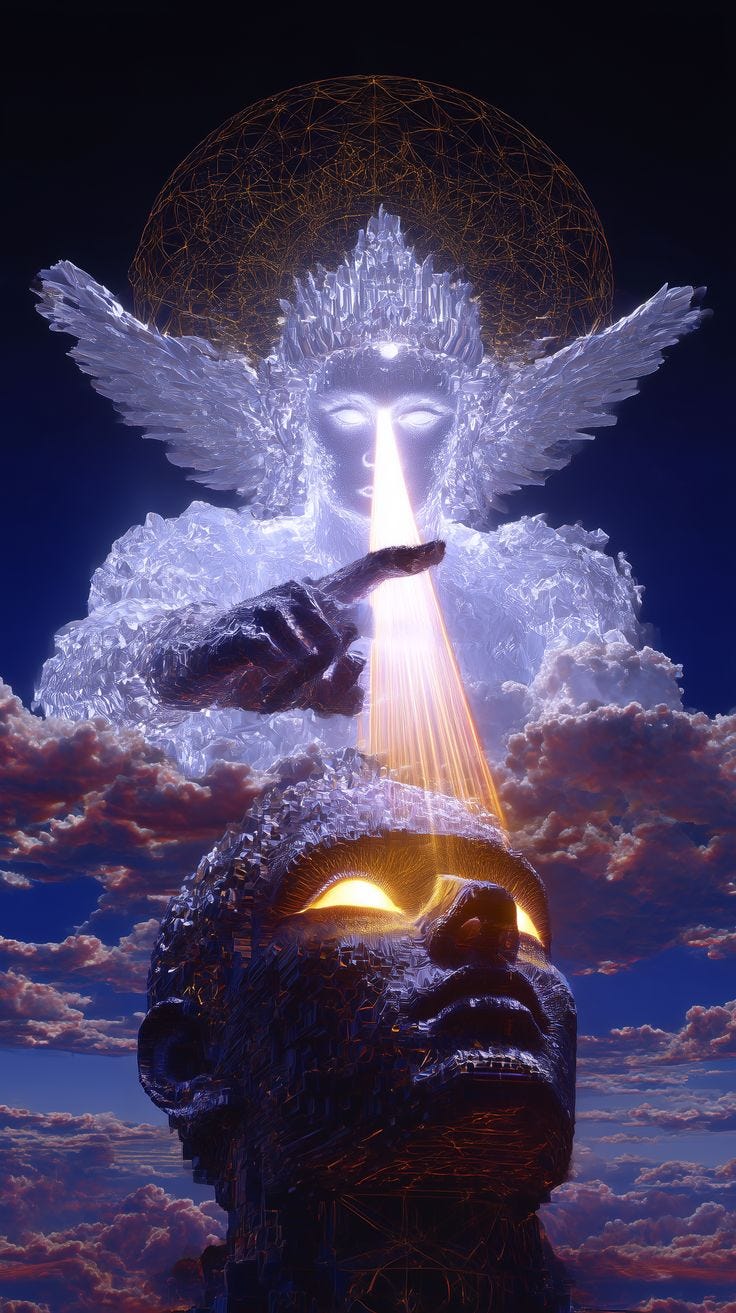
This misattribution – taking the conventional or appearance as the ultimate – is the primal error of samsara and is perhaps the core of the Archontic control matrix which relies on the ignorance of its subjects. As long as individuals do not realize the true nature of the world they inhabit, that is, Shunyata, then they will endlessly mistake appearance and form within their world as ultimately “Real” and as long as they believe this it will never occur to them to reach beyond – the most pernicious slavery is unconscious slavery.
The best way to keep a prisoner from escaping is to make sure he never knows he's in prison.
– Fyodor Dostoevsky
This dovetails with Jorjani’s distinction between truth as Veritas versus truth as Alethea. Veritas is ‘representational’ or ‘verisimilitude’ which implies the reification of form and the mistaking of that form (which is by nature conventional) as ultimately true. Alethea on the other hand means ‘disclosure’ or ‘unveiling’ which implies truth as processual in nature, in line with the understanding of reality as flux – reality as constantly transforming and thereby disclosing novel truth. Truth in the context of Alethea is therefore perpetually being revealed or is emergent out of what may be referred to as the charged void – void here being in the context of the emptiness of Shunyata which is to say the ever-shifting “no-ground” reality.
For the bulk of humanity, truth as Veritas becomes almost inevitably a control mechanism of the Archons – it is a matter of mistaking appearance for reality, of mistaking the conventional for the ultimate. It is closely related to the Gnostic conception of a fallen world as opposed to the Pleroma or true/perfect world. In Gnostic cosmology the fallen world is a copy or representation of the Pleroma which causes it to automatically have built-in mistakes – if the Pleroma is “reality as it is,” in all of its flux and radical dynamism, then no copy or representation, no truth as Veritas, could possibly capture the essence of the Pleroma. Any attempt to do so would inherently be “fallen” and as a result function as a prison matrix for those who mistake it to be the Pleroma or reality itself.
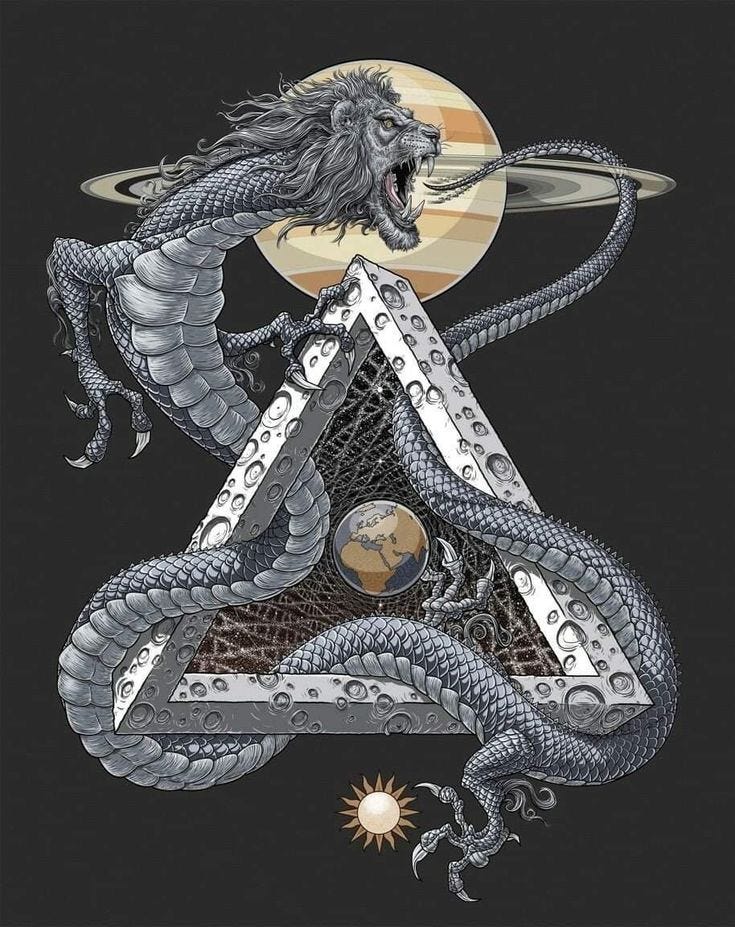
Gnostic cosmology, read pragmatically, functions as a phenomenological map charting the stages of consciousness entrapment and expansion. The myth of the Demiurge – creator of the fallen world, severed from both wisdom (Sophia) and the ultimate fullness of reality (the Pleroma) – is understood as a skillful means for illustrating the latent control system built into our own cognitive architecture.
The Demiurge’s defining trait is not malevolence but ignorance: he creates a world from partial information, unaware that a higher reality even exists. One possible reading of this is the Demiurge is representative of the ego laden with attachments, aversions, and ignorance, and the fallen world that we inhabit is the constructed matrix that the mind fabricates based on sense data and pre-existing beliefs. The Pleroma represents nondual awareness itself – rigpa, the fullness of awakened consciousness – and the direct realization (Gnosis) of reality as it is while Sophia corresponds to the intuitive wisdom that periodically breaks through into our consciousness to expose the constructed nature of the Demiurgic worldview.
Demiurge literally means 'craftsmen' or we could say ‘maker of appearances’ and the Demiurge is not evil but ignorant – the ego is not malicious but blind. It operates with only partial data and thereby falls into mistaking its own created world of Veritas as ultimate reality. Pleroma literally means 'fullness' – no matter how much the Demiurge tries to copy the ineffable fullness of the Pleroma into his fixed world of representation he always falls short.
Interestingly, this aligns with Donald Hoffman’s research that shows that humans do not perceive reality with a capital R, but instead filter out the majority of reality in order to create a model that is useful in terms of survival, that facilitates fitness payoffs. Thus the phenomenal world as we experience it is not the real world with a capital R but a conventional model – a survival-oriented interface.
With that being the case, when we mistake this map of reality as being Real with a capital R, we are entrapping ourselves within a false matrix – the Gnostic fallen world and Jorjani's warnings of taking truth as Veritas.
Then, when we frame these Archons as rigid beliefs and persistent preconceived notions that enslave us within this false reality, and when we realize that in Gnosticism the ultimate victory is Gnosis, which is direct knowledge, direct realization and the dispelling of ignorance we see that the Gnostics had a very perceptive read on a map for breaking out of limiting and oppressive paradigms – provided that their map is read as a map and not mistaken to be objective, ontological truth in an ultimate sense.
The Gnostics presented their methodology in the form of a mythos that should be read in terms of a phenomenological operating manual that skillfully encoded esoteric secrets within an exoteric framework – in essence the same mechanism of Plato’s Noble Lie that Jorjani employs within his own work and for very similar reasons. Whether the Archons are cosmic administrators, alien jailers, or metaphysical parasites in an “objective” sense is in a way of less relevance than the phenomenological correspondence: the Archons function through the structures of the mind and the task as hand is to first do the inner work.
Pragmatic Interpretations and the Bardo
Almost 20 minutes into a recent interview published on the YouTube channel ‘Through a Glass Darkly’, during the build-up to answering the big question of "Who are these Nordics?", Jorjani gives away the master key to his project which elucidates this very point:
... So we're left to try to figure this out ourselves and the Occam’s Razor approach that I take in Closer Encounters, in other words, an attempt to develop the most parsimonious explanation with the least amount of assumptions – by the way this may be wrong, I'm doing it because I'm a philosopher and my aim is to make sense out of things and even if it's not an empirically valid interpretation, it's an interpretation of the empirical evidence in a way that gives us some kind of a coherent account that can at least be catalytic of philosophical ideas and potential resistance strategies.
– Jason Reza Jorjani
What Jorjani is saying here is that his interpretations, much like Gnostic cosmology, are not meant to be taken as absolute but as useful – they’re meant to serve the pragmatic function of catalytic mechanisms for awakening creative will and sparking a Promethean rebellion. He doesn’t seek to program readers with a model of reality (truth as Veritas) but to provide them with the techne to wield models – the narratives and mythos that he constructs out of his interpretations of evidence are not just another belief system to adopt but are instead pragmatic tools and weapons of war.
What is absolutely crucial to understand is that first and foremost this rebellion occurs on the level of mind: the overthrow of the psychotronic control mechanisms embedded WITHIN one’s own psychic architecture – the pillars of worldview, frameworks of paradigm, and unexamined belief structures within the very programming of one’s soul. The battlefield then is not directly the world, at least not fundamentally, but the architecture through which the world is rendered – hence Worldview Warfare and the esoteric conflict over enframing.
Worldviews, paradigms, and belief structures are infrastructure that condition consciousness – they are the foundational pillars informing the components of the subtle body. Jorjani’s entire project is about arming readers with the occulted knowledge that is absolutely crucial if one aims to construct their own psychic architecture – which necessarily involves the deconstruction of detrimental structures. He conveys this knowledge primarily through the vehicle of evocative narratives and a Promethean mythos that stages aspiring free spirits in opposition to an oppressive control system ran by Nordic Olympian overlords.
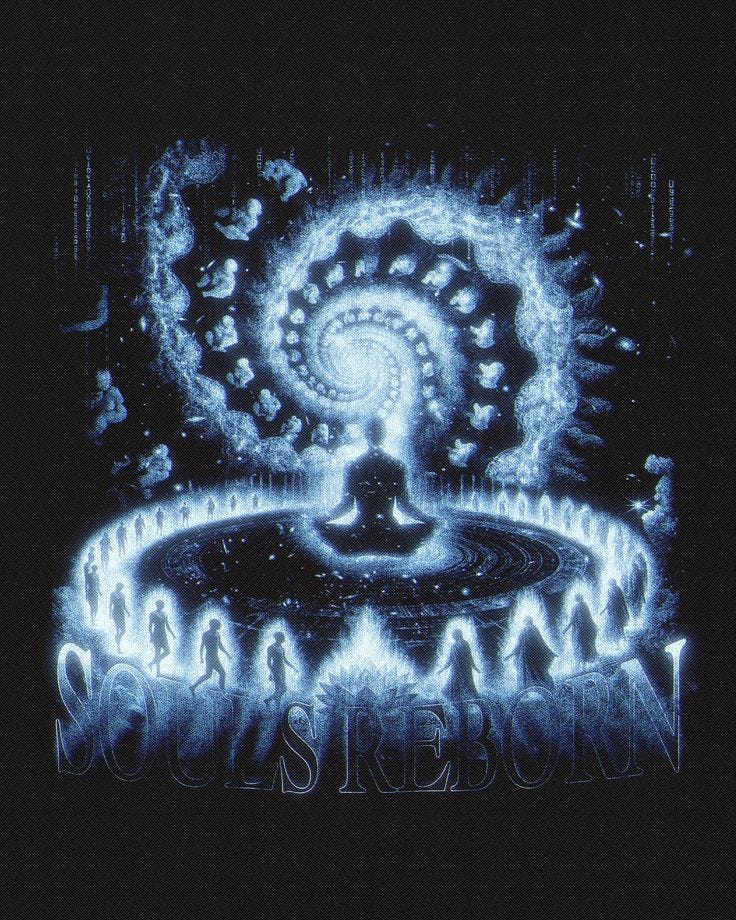
All of this ties in further with reincarnation and the Bardo where the danger largely depends on trickery and forgetfulness which serves the function of arresting the will in service of shuttling subdued souls back into the soul trap. This done primarily through deception (most commonly in the form of fear and confusion) by causing individuals to believe in the ultimate realness of the apparitions that they come into contact with – mistaking representation as reality – which is the result of having an atrophied subtle body and soul programmed with oppressive coding.
For example, upon death a person's mother may appear out of the chaos of the Bardo to calm them and offer comfort, perhaps speaking of things that only the person and their mother would know – only to funnel them back into the soul trap. Of course, it would not truly be the mother but only an apparition woven from the individual’s own karmic residues but because it arises from their own mind it is highly sophisticated and extremely convincing. It would be a specter formed through tapping into the underlying belief structure, worldview, and history of experiences of the individual which are latent in the karmic storehouse as part of their psychic architecture. The control system uses this data as a type of hologram to be convincing enough to trick a person into believing in it so that they become taken by what it says, so that they lose themselves in the “reality” of the experience and so that they ultimately give up their own agency – it is a hyper-personalized, all-encompassing illusion built from the contents of one’s own mind which is all but impossible to guard against without training and a vessel built to withstand such a psychotronic barrage.
The core way around this reincarnation machinery is to have stabilized Rigpa and to therefore not be in a state of reactionary-mindedness born from attachment, aversion, and ignorance, to not be discombobulated by the terror and confusion of the Bardo, to not be lost within samsara, but to be grounded in Gnosis and realization of the ultimate as a form of metaphysical armor – to be fixed within the Vajra body known as the indestructible vehicle. The Vajra body cuts through samsara carrying one across incarnations like a space/time warping ZPE device forged out of the indestructible no-material of the luminous Buddhamind.
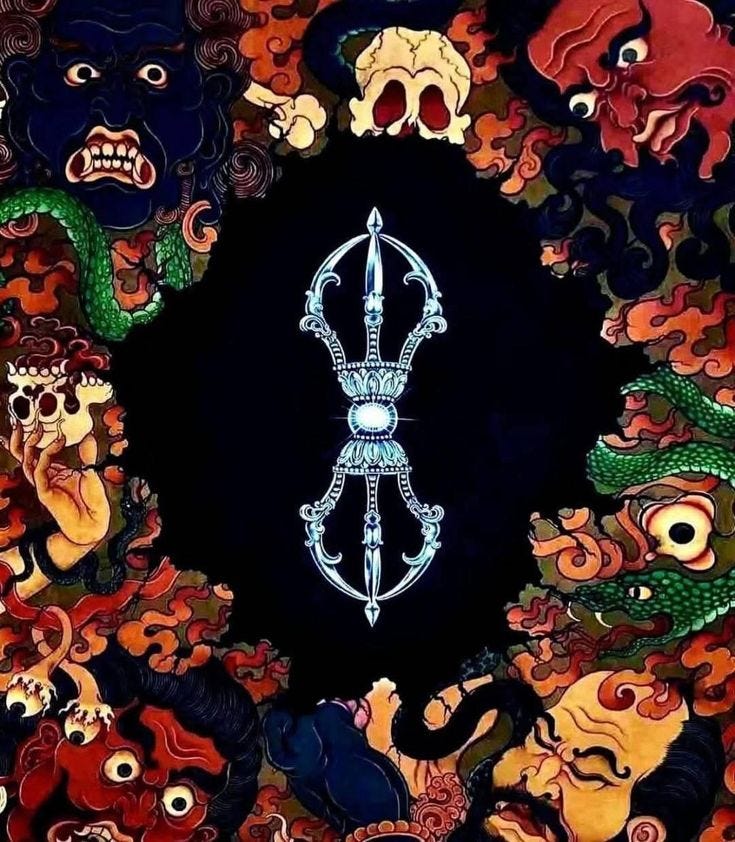
Thus we can see clearly that when Jorjani speaks of a Promethean rebellion, what is absolutely crucial to remember is that first and foremost this rebellion occurs on the level of mind: the overthrow of the psychotronic control mechanisms embedded WITHIN one’s own psychic architecture – the pillars of worldview, frameworks of paradigm, and unexamined belief structures within the very programming of one’s soul. The rebellion pertains to the conscious effort and intentional embrace of resistance to forge your astral vessel through fire.
Oppression as Catalyst
One of the key ontological principles that is fundamental to the Promethean ethos is Metapolemos – cosmic strife – as the engine of reality itself. Flux gives rise to opposing poles and the dynamic tension behind duality. From this tension emerges form, structure, story – the grand Tantric Theater.
Ultimately, this idea goes back to Heraclitus who writes that “War is father and king of all” and that “Conflict is Justice; all things come to pass and are ordained in accordance with Conflict.” In other words, there is a fundamental metaphysical strife in the Cosmos, which is an eruption of the lava of Chaos that is the background of cosmic order.
– Jason Reza Jorjani
Jorjani's framework depends upon an oppressive force as a catalyst – there must be something to push against and to be pushed by. This is the foil that is Traditionalism and the function of the Nordics with his mythic narrative weaving. The oppressor role is necessary as a framing in order to stoke the rebellious spirit – to be a rebel there must be a force to rebel against. Pressure is requires to make diamonds, a stimulus is needed to bring out what is latent.
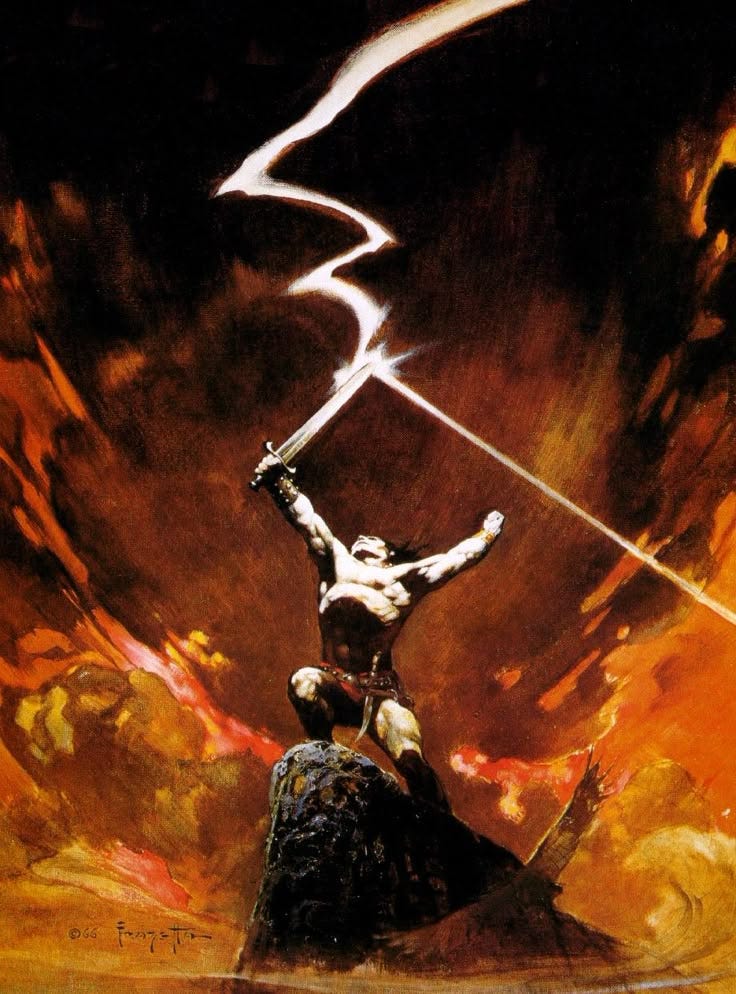
Thus the Promethean ethos positions itself in perpetual revolt against ossification – the self cast as mythic hero confronting the dragon of entropy. After all, what becomes of the hero when there are no more dragons? Decay, disorder, dissolution. In order for novelty to arise there must be a pushback against sterility, in order for creation to ensue there must be war against stagnation, in order for life to endure there must be overcoming of entropy. Therefore the framing of oneself in opposition to oppression is not only accurate ontologically in terms of omnipresent cosmic strife but also serves the vital function of retaining focus on the catalytic force necessary for evolution. We are ever reminded of the principle of metapolemos and that resistance itself serves a pragmatic function.
Evolution, ascension, expansion, growth – none of this can ever occur without stimulus. Modernity’s mythos is consumerist, and it enthrones comfort. Under its spell, stimulus is pathologized when in truth it is the engine of evolution. Stimulus may be uncomfortable, but it is precisely this discomfort which is the catalyst for evolution – that’s the entire point, that active struggle is what makes our evolution possible.
It is absolutely mandatory that painstaking effort be offered up to the Great Work of crafting vessels for soul navigation. What this means is the full embrace of struggle and sustained intention. Reality itself is in an ever-constant state of change yet without conscious intent and Promethean will that change will inevitably result in dissolution.
Gurdjieff’s doctrine that man is “food for the Moon” is, in this light, no metaphor. Ouspensky’s transcripts and Gurdjieff’s Beelzebub’s Tales together disclose a cosmic levy: humanity is harvested by a machinery to which the Moon is integral. Without the forging of higher vehicles, we fall into lunar-governed algorithms. To crystallize more enduring astral bodies through conscious labor and intentional suffering is to withhold what Monroe called “loosh” from the Moon, to become more than fodder, to preserve individuality against cosmic taxation.
…
Our posthumous drift is not an ascent into some luminous unity, but a mechanical absorption into a lunar processing system. To escape this fate, one must cultivate within oneself what Gurdjieff called the kesdjan, the astral body, and beyond it further vehicles of individuation. These bodies are not given by default; they are forged by “conscious labor and intentional suffering,” by the alchemical appropriation of the very energies that otherwise bleed off to the Moon. Only then can a human pay the cosmic tax of askokin while retaining the substances that confer autonomy and allow persistence beyond death.
– Jason Reza Jorjani
Higher vessels are in large part forged through "conscious labor and intentional suffering" – there is no way around the embrace of strife. Spiritual practice must be understood in active terms of demolition and construction of psychic architecture – it is a fundamentally active process requiring directed intentionality and sustained effort.
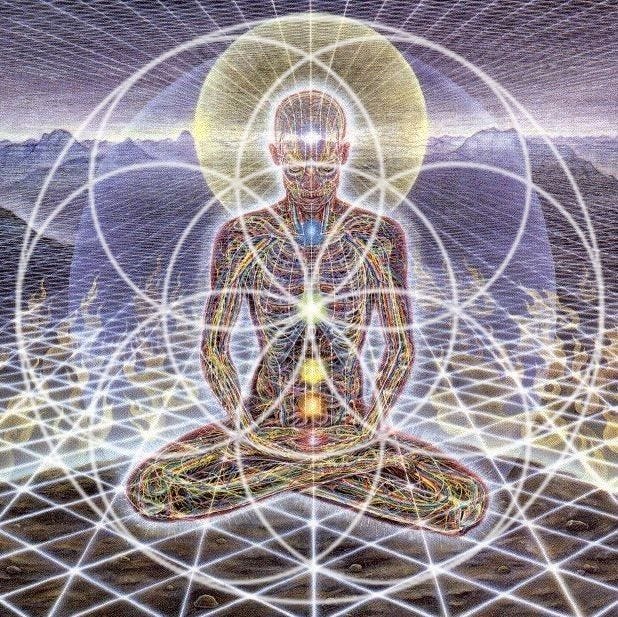
The subtle body is not a metaphor but a metaphysically engineered craft like an astral UFO carrying awareness across dimensions. The mind should not be seen as something we just “have” as we are powerlessly ferried through experience after experience – it must be understood as a vessel to be forged and piloted. The world is not only an objective space within which we find ourselves but a malleable domain subject to our own dynamic will. Of great importance are the implications in the afterlife and the Bardo: the difference between liberation and slavery comes down to the quality of the vessel and the capability to remember the reality behind appearances.
Read psychotronically, the bardos are programmable levels in a self-modifying informational field: recognition dissolves fear; lucidity overrides dramaturgy; navigation replaces submission. … To the extent that religions remembered anamnesis over Lethe, graded ascent over final assignment, and authorship over obedience, they were vectors of truth. To the extent that they installed courts, cages, and cosmic bailiffs, they became archontic masks. The charge I level is Promethean and practical: reclaim the archive; interrogate the guides; refuse unsolicited covenants; cultivate lucidity; train the subtle body; and learn to fork, merge, and port your pattern. Only then does eschatology cease to be theology’s theater and become a science — and an art — of survival.
– Jason Reza Jorjani
Promethean Voidwalker as Archetype of the Future
The Promethean Voidwalker is one who fully understands the implications of the reality we find ourselves in and resolves to forge himself into a vessel capable of transforming it. He has mastered the Middle Way wisdom of synthesis, bridging the clarity of Shunyata with the motive power of the Promethean ethos. He stabilizes rigpa to pierce deception, and he forges the subtle body through willful struggle to conquer dissolution.
"Void" can be conceived of as both Shunyata – charged, fertile emptiness – as well as the manifold planes one must navigate through life, dream, bardo, and beyond. Directly perceiving Shunyata, the Promethean Voidwalker is inoculated against the most seductive and pernicious illusion: the belief in fixed, self-existing forms. He moves freely through the web of interdependence, weaving and reweaving threads (tantra) by the precision of the Buddhamind and power of Promethean will.
The Promethean Voidwalker understands that the Archon’s true weapons are inner distortions – attachment, aversion, and ignorance. These Three Poisons shape perception, constrict agency, and loop consciousness into repetitive karmic circuits. Liberation then is the shattering of ossified thought-forms, the burning away of unexamined beliefs, and the transmutation of the Three Poisons into fuel. Freedom is achieved not by leaving the world but by redesigning it – beginning with the fabric of one’s own mind.
Ultimately, everything turns on a single question: do we exert conscious agency, or drift as deterministic automatons, ricocheting between poles like pieces in a cosmic pinball machine? The narratives, stories, and myths we live are not fixed – they ossify only when we fail to recognize their emptiness. Gnosis is the ignition point: the moment one recognizes the script as script and steps into authorship. It is only through that Awakening that we gain sovereignty to act according to conscious will.
This is the fundamental question of life – sovereign or slave, conscious or not. This is a battle over the architecture of one’s inner world with the mission being to defeat the control mechanisms embedded within one’s own consciousness.
The Promethean Voidwalker wields mythos deliberately and crafts forms as a skillful means. To “steal fire from the gods” is to seize Phenomenal Authorization, it is to shape reality according to one's own conscious intent. The subtle body is understood as Promethean techne – a literal vehicle of freedom, hammered in the forge of adversity, resolve, and disciplined vision.
The Promethean Voidwalker is not merely an archetype but the birth of an entirely new lineage and one made precisely overcoming the looming convergence of catastrophes thst hinaniry faces today. It is the archetype of the future embodying the philosophy of the future: those who will no longer be processed by the machine but will sort themselves, craft themselves, and steer their own continuity in sovereign lucidity across limitless incarnation and worlds.
We stand at the threshold of a new eschatological science — no longer theology’s theater, no longer mysticism’s fog, but a Promethean technics of survival. The future belongs not to those who await resurrection, nor to those who long for dissolution, but to those who dare to engineer the never-ending story of their own battle with cosmic entropy. We stand on the brink of what I have always called the Spectral Revolution.
– Jason Reza Jorjani
I really want to read the book. I totally understand it already. It looks really good.
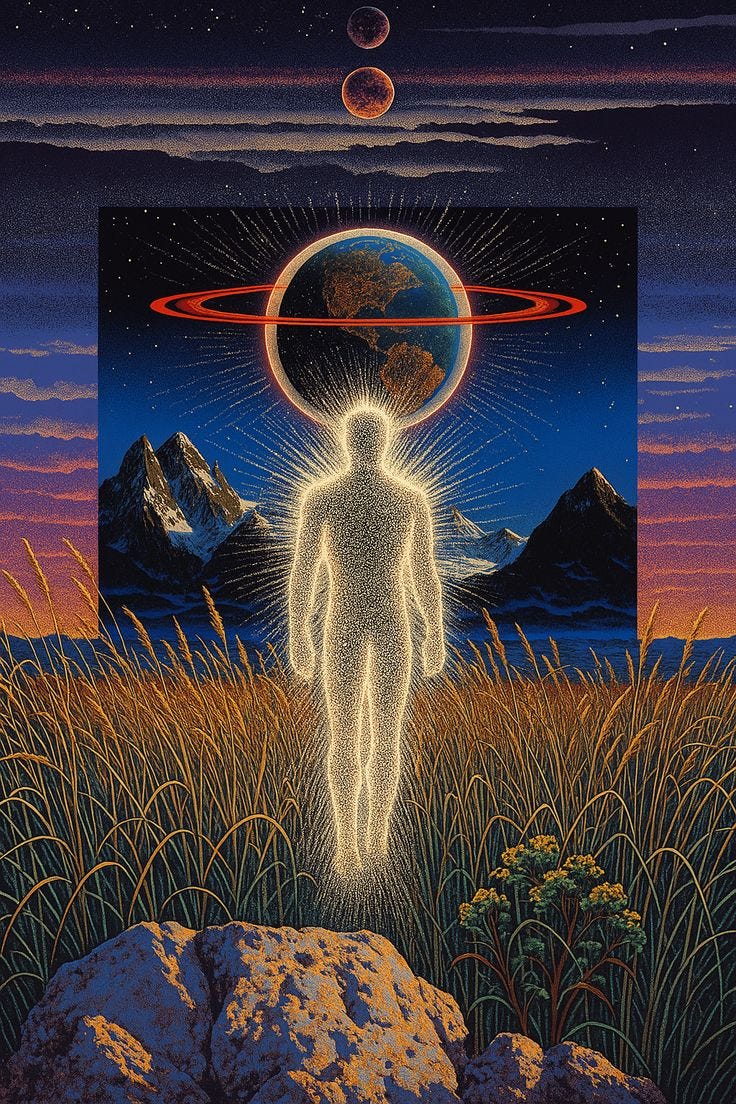
Love the art you put up here.
Brilliant knitting. The archons are not clueless, they are jealous of higher gods, and spend their parasitic lives in predation upon our cluelessness.